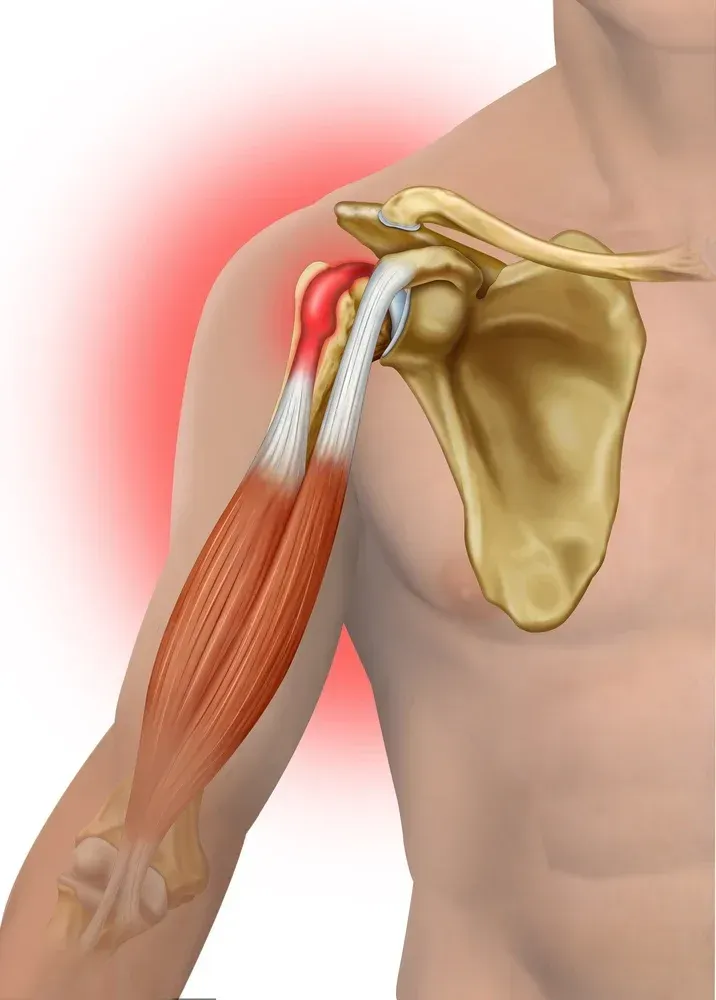
Bicep Tendon & Anterior Shoulder Pain in Pitchers: Tips for A Successful Rehab
Bicep Tendinopathy & Anterior Shoulder Pain in Pitchers: Tips for A Successful Rehab - Lewis Physical Therapy & Sports Rehabilitation
Bicep tendon pain is one of the more common complaints we see in baseball players, especially pitchers. It usually shows up as pain right along the front of the shoulder, and a lot of athletes can point directly to the irritated spot. But while many players assume the bicep tendon itself is the whole problem, that is usually not the full story.
What You’ll Learn in This Blog
In this blog, you’ll learn:
why bicep tendon pain shows up in throwers
what shoulder strength and stability issues often contribute to it
why scapular mechanics matter
how shoulder range of motion can influence symptoms
what to actually focus on in rehab
🎥 Watch the full video on YouTube
If you’re dealing with anterior shoulder or bicep tendon pain while throwing, this video breaks down the most common causes and what needs to be evaluated to fix it.
▶️ Watch Now on YouTube:
Why the Bicep Tendon Gets Irritated in Throwers
The long head of the bicep has a strong anatomical connection to the superior labrum. That means chronic bicep tendon pain in throwers can sometimes be associated with deeper shoulder issues, especially in athletes who have had symptoms for a long time.
Pain can also show up at different parts of the throwing motion. Some athletes feel it during layback, when the bicep undergoes significant torsional stress and creates a "peel-back" mechanism ("peels" the labrum off the glenoid to achieve greater amounts of laybck). Others feel it coming out of acceleration or around ball release. That difference matters because it can point to different stability and force-production issues.
The important thing to realize is that the bicep tendon is rarely the main source of the problem. In many cases, it is due to issues on the posterior (back) of shoulder.
Rotator Cuff Strength Matters
One of the first things we want to look at is cuff strength, especially the relationship between internal and external rotation strength. If the cuff is not strong enough — or if the shoulder cannot stay centered in the joint while creating rotation — the front of the shoulder can take on too much stress.
This is also why some throwers do poorly with basic external rotation exercises early on. If banded ER or sidelying ER reproduces pain in the front of the shoulder along the bicep tendon, that usually tells us the shoulder is not controlling anterior humeral glide well enough yet. In those cases, simply adding more cuff work is not always the answer.
Scapular Control Is a Huge Piece
The scapula acts like the shelf the shoulder moves off of. If it is not rotating upward well or staying in a good posterior tilt, the shoulder can run out of space and shift forward. That often increases stress on the bicep tendon.
This is why lower trap and serratus function are so important. In many athletes, improving scapular mechanics changes symptoms fast. If manual upward rotation or posterior tilt immediately improves pain during testing, that is a major clue for what needs to be emphasized in treatment.
Don’t Ignore the Subscap
Another key piece is subscapularis function. The subscap helps create internal rotation while also helping resist the shoulder from dumping forward. For throwers who lose control during acceleration, this can be a major missing link. When trained appropriately, it can help create a better posteriorly directed force and unload the front of the shoulder.
Range of Motion Still Has to Be Assessed
Shoulder motion matters too — but it has to be interpreted correctly. We want to assess:
total rotational range of motion
shoulder flexion with and without the scapula pinned
cross-body adduction
Some throwers need mobility work. Others already have plenty of motion and actually need more stability, not more stretching. That’s why the exam matters. Looking at total motion, internal rotation differences, and cross-body mobility helps determine what the shoulder actually needs.
Final Thoughts
If you are a baseball player dealing with bicep tendon pain, the fix is usually not just resting, icing, or doing random band exercises. You need to understand whether the real issue is coming from cuff weakness, poor scapular control, subscap dysfunction, range-of-motion deficits, or a combination of all of the above.
That’s exactly how we approach it at Lewis Physical Therapy & Sports Rehabilitation. We assess the full picture so you can stop guessing and start building a plan that actually gets you back to throwing pain-free.
🗓 Ready to throw Pain-Free? Book Your Evaluation Today
If shoulder pain, elbow pain, or nagging injuries are slowing you down, there’s a proven path forward.
👉 Book your evaluation here: https://go.dptpreneur.com/widget/form/zt52az6nu2DnPG0S4SyG
Online Training Programs For Adults & Athletes:
https://www.trainerize.me/profile/lewisphysicaltherapyandsportsrehablitation/Jeff.LewisPTDPTATCCSCS/
🎙 Listen to This Episode on The Lewis Physical Therapy & Sports Rehab Podcast
Catch the full breakdown of how throwers can address bicep tendon pain by improving cuff strength, scapular mechanics, and shoulder control.
🎧 Listen on Spotify: https://open.spotify.com/show/4A6iBs0CzkAwSu9rUVPfGX?si=lrea2AaWQSy5USIT90KXhQ
Free Resources
📘 The Arm Pain Blueprint (FREE Download!)
Text “Arm Pain” to 732-724-1381
⚾ Pitcher’s Mechanical Blueprint (FREE GUIDE)
👉 https://go.dptpreneur.com/widget/form/n11cl2tkQwwi9BfjnWpz
