When Can You Start Running After a Hamstring Strain?
When To Start Running After a Hamstring Strain - A Smarter Approach to Hamstring Rehab
Hamstring strains are one of the most frustrating injuries for athletes because they’re notorious for lingering symptoms and high reinjury rates. One of the biggest mistakes we see during rehab is delaying running for too long.
In this blog, you’ll learn:
How hamstring strains are classified
Why injury location matters for recovery timelines
Clinical signs we use to determine running readiness
Why pain-free walking is a major milestone
Early hamstring loading strategies
Why running itself is one of the most important rehab tools
How to reduce deconditioning during recovery
🎥 Watch This Week’s Video on YouTube
Wondering when it’s safe to start running after a hamstring injury?
In this video, I break down exactly how we determine when athletes are ready to begin a running progression after a hamstring strain — and why many athletes wait too long to reintroduce sprinting and movement.
▶️ Watch Now on YouTube:
Why Hamstring Strains Are So Challenging
Hamstring strains can be difficult because every injury presents differently.
Some athletes experience a mild overstretching injury and are back running quickly. Others sustain more significant tendon or musculotendinous injuries that require a much longer progression.
One of the first things we evaluate is:
Injury severity & location
Strength deficits
Range of motion limitations
Understanding these factors helps determine how aggressive or conservative the rehab process needs to be.
Hamstring Strain Grades Explained
Grade 1 Hamstring Strain
A Grade 1 injury is typically a mild overstretching of the muscle fibers.
Athletes with Grade 1 strains often:
Have minimal strength loss
Can still walk relatively normally
Have mild range of motion limitations
Experience discomfort but not severe pain
These athletes can often begin movement-based rehab fairly early.
Grade 2 Hamstring Strain
A Grade 2 injury involves a more significant partial muscle injury.
These athletes commonly present with:
Noticeable weakness with hamstring testing
Pain during walking
Significant range of motion loss
Difficulty generating force
These injuries generally require a more structured loading and running progression.
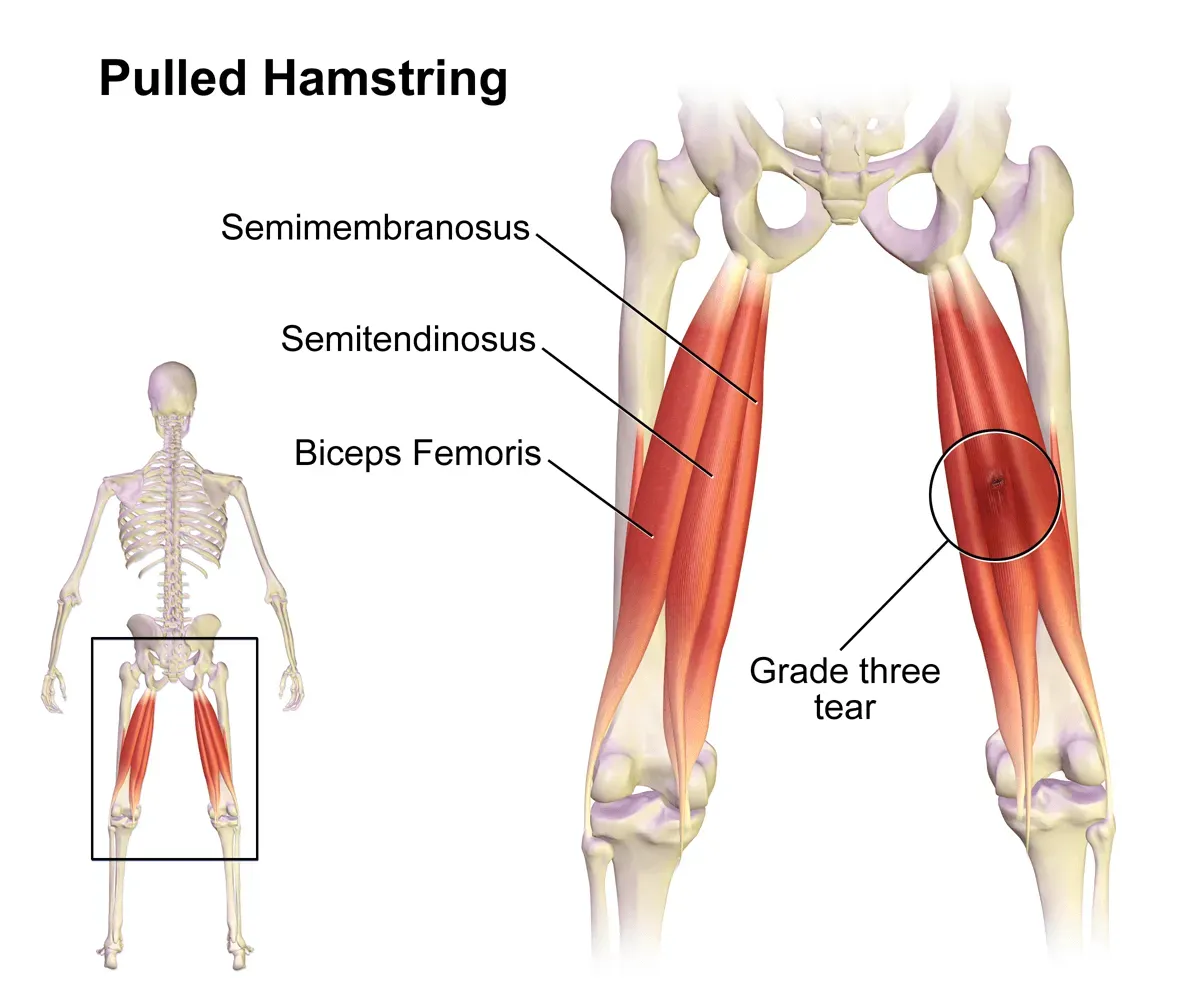
Grade 3 Hamstring Strain
Grade 3 injuries involve a complete rupture and are far less common.
These athletes typically:
Cannot generate force through the hamstring
Have severe pain and dysfunction
Struggle significantly with walking and basic movement
These injuries often require much longer rehab timelines and sometimes surgical intervention.
Why Injury Location Matters
Not all hamstring strains behave the same way.
Sprint-related hamstring strains commonly occur at the musculotendinous junction of the biceps femoris — the area where the muscle blends into the tendon.
Generally:
Muscle belly injuries heal faster
Tendon-based injuries take longer
Proximal hamstring tendon injuries near the ischial tuberosity are often more stubborn
Central tendon injuries can prolong recovery timelines
This is why two athletes with “hamstring strains” can have completely different rehab timelines.
How We Determine If an Athlete Is Ready to Run
One of the biggest clinical signs we look for is simple:
Pain-Free Walking
Once an athlete can walk pain-free, we typically begin introducing some level of jogging or movement progression.
This surprises a lot of people because many rehab programs delay running much longer than necessary.
The reality is:
Slow jogging does not place maximal stress on the hamstring
Early controlled movement helps restore confidence
Movement improves conditioning and tissue adaptation
Avoiding movement for too long often prolongs recovery
The key is introducing the right type of running at the right time.
Early Hamstring Loading Matters
We also begin loading the hamstring early — even if it’s very low level initially.
That may include:
Isometric bridge holds
Double-leg bridge variations
Light prone hamstring contractions
Controlled eccentric sliders
The goal early on is to:
Introduce safe stress to injured tissue
Improve tissue tolerance
Maintain neuromuscular function
Prevent excessive deconditioning
A completely unloaded hamstring is usually not a healthy hamstring.
Movement Drills We Use Before Running
Before progressing into higher-speed sprinting, we often introduce extensive movement drills such as:
Ankling drills
Marching drills
Pogos
Skipping progressions
These drills help:
Restore rhythm and coordination
Reintroduce force absorption
Improve foot and ankle stiffness
Prepare the athlete for sprint mechanics
Most importantly, they get athletes moving again confidently.
Running Is the Primary Stressor
One of the biggest misconceptions in hamstring rehab is believing that endless gym exercises prepare athletes for sprinting.
The truth is:
Nothing replicates the stress of sprinting like sprinting itself.
Strength work is important, but progressive running exposure is the main driver of hamstring rehab.
The key is gradually progressing:
Distance
Speed
Intensity
Sprint exposure
Deceleration demands
Done properly, this allows the hamstring to adapt safely over time.
Don’t Stop Training During Rehab
One of the worst things athletes can do during a hamstring injury is completely stop training.
We continue training:
Upper body strength
Core work
Conditioning
Medicine ball work
Non-provocative lower body training
This helps maintain:
Nervous system output
General conditioning
Strength levels
Athletic confidence
The longer athletes completely shut things down, the harder the return becomes later.
Final Thoughts
Hamstring rehab should not be based on fear of movement.
The goal is to:
Progressively load the hamstring
Reintroduce running early when appropriate
Gradually build sprint tolerance
Maintain overall athleticism during rehab
If you’re dealing with recurring hamstring strains, lingering tightness, or difficulty getting back to sprinting, a structured progression matters.
🗓 Ready to Get Out of Pain? Book Your Evaluation Today
If hamstring pain, recurring strains, or sports injuries are slowing you down, there’s a proven path forward.
👉 https://go.dptpreneur.com/widget/form/zt52az6nu2DnPG0S4SyG
Online Training Programs For Adults & Athletes
Build strength, improve movement quality, and train smarter with our online training systems:
👉 https://www.trainerize.me/profile/lewisphysicaltherapyandsportsrehablitation/Jeff.LewisPTDPTATCCSCS/
🎙 Listen to This Episode on The Lewis Physical Therapy & Sports Rehab Podcast
Catch the full breakdown on hamstring rehab, sprint progressions, and return-to-running strategies.
🎧 Listen on Spotify: https://open.spotify.com/show/4A6iBs0CzkAwSu9rUVPfGX?si=lrea2AaWQSy5USIT90KXhQ
📘 The Arm Pain Blueprint (FREE Download!)
Text “Arm Pain” to 732-724-1381
⚾ Pitcher’s Mechanical Blueprint (FREE GUIDE)
👉 https://go.dptpreneur.com/widget/form/n11cl2tkQwwi9BfjnWpz
