How to Rehab Rotator Cuff Injuries in Adults and Return to the Gym Safely
How to Rehab Rotator Cuff Injuries in Adults and Return to the Gym Safely – Lewis Physical Therapy & Sports Rehab
Shoulder pain can be incredibly frustrating for active adults who want to keep lifting, training, and staying consistent in the gym. One of the most common presentations we see is rotator cuff-related shoulder pain in adults who are active, still training, but are starting to notice pain with sleeping, reaching, pressing, or overhead movement.
What You’ll Learn in This Blog
In this blog, you’ll learn:
Common symptoms associated with rotator cuff-related shoulder pain
Why certain traditional rehab exercises can make symptoms worse
The importance of scapular control and subscapularis strength
How to return to lifting with smarter movement progressions
Why rowing, closed-chain work, and controlled pressing progressions matter
Watch This Topic on YouTube
If shoulder pain is limiting your workouts, this video breaks down how to approach rotator cuff rehab and safely get back to lifting.
▶️ Watch on YouTube:
Common Signs of Rotator Cuff-Related Shoulder Pain
A common pattern we see is active adults between 30 and 55 years old with a gradual onset of shoulder pain. These individuals usually want to keep training, but they begin noticing symptoms that interfere with workouts and daily life.
Some of the most common symptoms include:
Pain sleeping on the involved side
Pain down the side of the upper arm (not down to the hand...if this is the case, need to be evaluated for cervical nerve root involvment)
A painful arc during arm elevation out to the side
Pain reaching out to the side or forward (think reaching for the car radio)
Trouble with pressing (i.e. bench pressing) and overhead lifting
When symptoms stay more around the shoulder and upper arm, rotator cuff involvement becomes more likely. If symptoms travel further down into the hand or fingers, that may warrant evaluating for other issues like cervical or nerve-related involvement.
Why Traditional Rotator Cuff Rehab Can Miss the Mark
A lot of people are told to do endless band external rotations at their side. While that can be useful in the right setting, it is not always the best starting point.
For many active adults with irritable rotator cuff symptoms, those drills can actually be more provocative, especially if the shoulder lacks stability. In some cases, they can increase symptoms around the front of the shoulder or irritate the biceps tendon.
That’s why rehab should not just focus on isolated cuff exercises. It needs to address how the entire shoulder functions.
The Role of the Shoulder Blade in Shoulder Pain
A major part of successful shoulder rehab is improving scapular mechanics.
When the shoulder blade does not upwardly rotate or posteriorly tilt well during arm elevation, the shoulder joint often compensates. That can lead to more compression, more irritation, and more strain on already sensitive tissues.
This is why strengthening the lower trapezius and serratus anterior is such a big part of our rehab progressions. The shoulder blade has to move well if the shoulder joint is going to tolerate lifting again.
Why the Subscapularis Matters
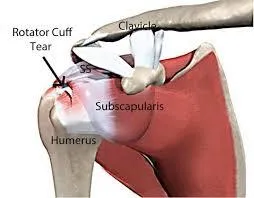
The subscapularis often gets overlooked in rotator cuff rehab, but it plays a huge role in helping control the humeral head.
In addition to being an internal rotator, the subscapularis helps resist excessive forward movement (also known as anterior translation) of the humeral head. That becomes especially important in people who already feel irritation in the front of the shoulder with pressing and lifting.
If you are only focusing on external rotation work and ignoring subscapularis function, you may be missing a big piece of the puzzle.
How We Progress Back to Lifting
When someone is trying to return to the gym, we do not usually rush into pressing.
Instead, we typically build the foundation in this order:
1. Start with rowing patterns
Rowing tends to be tolerated earlier than pressing because it helps restore scapular control and reduces the tendency to overload the front of the shoulder. Just make sure when you row, you aren't excessively pulling your arm past your trunk/mid-line.
2. Add closed-chain shoulder work
Exercises like tabletop weight shifts, shoulder taps, planks, and bear crawl variations are great because they encourage co-contraction of the rotator cuff and scapular stabilizers. That helps improve joint control and shoulder stability.
3. Reintroduce pressing slowly
Once the shoulder has a better foundation, we usually reintroduce pressing in stages:
Block push-ups
Floor pressing
Dumbbell bench press
Barbell bench press later
4. Progress overhead work carefully
Overhead pressing usually comes last. A landmine press is often a great place to start because it allows a more controlled overhead angle before moving into dumbbell or kettlebell pressing and eventually more demanding overhead work.
A Smarter Return to Upper Body Training
One of the biggest mistakes active adults make is trying to jump straight back into the exercises that are most provocative.
Just because you used to tolerate bench press, strict overhead press, or dead-hang pull-ups does not mean those are the right early-stage options when your shoulder is irritated.
A smarter return to lifting means earning those movements back through better stability, better scapular mechanics, and better exercise sequencing.
Final Thoughts
If you are an active adult dealing with rotator cuff-related shoulder pain, the goal is not just to calm symptoms down. The goal is to rebuild the shoulder in a way that allows you to train hard again without constantly flaring things up.
That means:
Improving scapular mechanics
Building rotator cuff stability
Strengthening the subscapularis and surrounding musculature
Using rowing and closed-chain drills early
Delaying pressing until the shoulder is ready
Done the right way, rotator cuff rehab can help you get back to lifting with confidence.
🗓 Shoulder Pain Keeping you from Training? Book Your Evaluation Today
👉 https://go.dptpreneur.com/widget/form/zt52az6nu2DnPG0S4SyG
Online Training Programs For Adults & Athletes:
https://www.trainerize.me/profile/lewisphysicaltherapyandsportsrehablitation/Jeff.LewisPTDPTATCCSCS/
🎙 Listen to This Episode on The Lewis Physical Therapy & Sports Rehab Podcast
Catch the full breakdown of how to structure shoulder rehab and return to lifting safely.
🎧 Listen on Spotify: https://open.spotify.com/show/4A6iBs0CzkAwSu9rUVPfGX?si=lrea2AaWQSy5USIT90KXhQ
Free Resources:
📘 The Arm Pain Blueprint (FREE Download!)
Text “Arm Pain” to 732-724-1381
⚾ Pitcher’s Mechanical Blueprint (FREE GUIDE)
👉 https://go.dptpreneur.com/widget/form/n11cl2tkQwwi9BfjnWpz
